hckrnws
This one really bothers me. Whenever maximizing or tiling my windows (which is all the time), I see multiple layers of oddly rounded corners.
I think if there's any upside to Tahoe, the grievances may push me into blogging for the first time ever, because I can't keep these to myself.
I actually feel sorry for Apple's developers because there's no way you ship software this bad and inconsistent unless you've been handed a terrible design spec from Dye's team.
edit: On my screen, three layers' corners https://hcker.news/tahoe-corners.png

There is so much of that in modern apple. Clear issues caused by a seemingly bright idea, but the idea still pushed forward no matter what.
One example that I hate on iOS: the notification/lockscreen curtain is supposed to cover the content as it slides down. That’s what a curtain does, this has been the language for years. Now the curtain is transparent, so it can’t cover the content behind. How does the content disappear then, as you slide the curtain down?
… it doesn’t. Icons do a buggy looking animation crashing toward the user and through the screen, and if it’s an app there is just no transition. You can check by sliding the curtain down slowly and then letting go.
> seemingly bright idea
i disagree about that one.
im not a UX expert by any means but my first impression at WWDC seeing liquid glass was "holy shit, they pulled that off? i know apple would never compromise on legibility, so... how? there are so many situations where this won't work, and they can't exactly control the content that the buttons are overlaid on top of"
cue my confusion when it was exactly that: an obviously problematic idea implemented with all the obvious flaws showing up
they have largely fixed it now, half a year later, but the liquid glass isn't very liquid anymore. it's frosted. which is fine, but obviously not the original idea they were going for
contrasty backgrounds are fundamentally incompatible with legibility
>im not a UX expert by any means but my first impression at WWDC seeing liquid glass was "holy shit, they pulled that off? i know apple would never compromise on legibility, so... how? there are so many situations where this won't work, and they can't exactly control the content that the buttons are overlaid on top of"
That's what I mean, even if worded badly. Someone probably managed the glass distortion effects as an experiment, or demoed a transparent redesign of a small portion of the UI, and it looked awesome. I think it's cool that they can green light weird ideas, otherwise there's stagnation. But it is obvious that there were fundamental unresolved issues, and yet something in the process pushed the idea forward anyway.
It signals something very wrong in company structure. If you can't trust the process to drop what doesn't work, then trying new things is risky. And as you say, it's an experiment that feels so unlike apple, to disregard polish and accessibility that way.
... liquid glass isn't very liquid anymore. it's frosted.
If they had simply put the clear glass on top of a heavily frosted shelf, maintaining a clear divide between content and control and making sure the clear glass was never directly on content, we would be discussing the ways to improve the design instead of everybody's dismissal of the whole thing.
I think a primary concern when Apple evolves their new design language nowadays is competitive differentiation. Because so many people try to clone their UI, they seek to add visual elements like frosting, glass, squircles, etc. that are difficult or impossible to achieve in competing platforms. Gradually others catch up and they need to evolve it again. Liquid Glass seems like an aesthetic choice made purely for the technical difficulty of the simulated physics necessary to accurately recreate it.
Wouldn't that imply that design is solved (at least regarding visual elements discussed here)? Then why not move onto other things? Why self-sabotage their success?
If I'm being cynical: because the design team at Apple needs something to do.
A lot of bad, unwanted features get written purely because "developers need something to do" and the same thing happens on the design side. I spent over a decade as a developer at various companies fighting bored designers who just had to redesign the look and feel of the app over and over because the current one was "stale" and "lacked pizzazz and pop!" But, then we devs would do the same thing to the feature list, refactoring and reimplementing and adding features for the sake of writing software, so... I was a hypocrite to complain.
That's probably not even cynical.
If AR/VR took off then something along the lines of liquid glass would be the only option for the entire design space. Early on there's going to be a lot of embedding of app context into the AR/VR setting to get a jump-start on content. But if people are going to be walking around with rectangular panes around their head, it's better that part of the app chrome is transparent.
Is this compromising readability? Yes, but now there's another kind of perception problem, and it's whether you can see what's literally in front of your eyes in physical space.
The AR push is also an issue in itself. There are very fundamental issues that remain unresolved, and I would say untackled even.
VR setups make you isolated and vulnerable. Any VR device is really awkward to use in public (read: in your living room or in an office).
In turn, AR setups that let the world through reduce image quality by virtue of being transparent, and it is unclear that they provide advantages. You get a slightly more immediate access to notifications in return for permanently pointing a camera towards anything you look at, which is understandably not well received.
And that's just for content consumption. When you introduce work, input is still significantly worse unless you're sitting in front of a keyboard and mouse, in which case you might as well have a full laptop.
> i disagree about that one.
Why ? I'm sick of square windows. I want disc windows. And instead of scrolling them, i want to rotate them. /s
Fixing bugs is hard. Better focus on the aesthetics.
I've got great news for you! https://en.wikipedia.org/wiki/Shape_extension
Ooh - did this carry forward into Wayland?
Kinda-not-really? Wayland has wl_region objects and wl_surface_set_input_region but wl_region only has axis-aligned rectangles. you'd end up approximating the circle (or whatever shape) as a union of horizontal rect slices, rather than a pixmap. you can't just hand over a pixmap mask, you have to decompose the shape into rects yourself.
Recall back when Apple had the attention to detail required to implement a Blackberry style thumbwheel as the volume control in the Quicktime Player.
This one has always confused me. And then, to be even more confusing, if you start sliding up slowly, the background does not disappear. It stays this time around. Pull down slowly, no background, just the glass effect. Pull up slowly, still have the background, no glass effect. I guess I don't necessarily hate it, it's more of a neutral thing, but who is deciding these strange things??
>I guess I don't necessarily hate it, it's more of a neutral thing, but who is deciding these strange things??
Probably nobody, just some artifact of the overlay APIs used default behavior that they didn't bother to streamline.
In this case, the behavior is so weird and easy to trigger that I'm sure someone has filed a radar by now. So somebody has at least written a post-hoc justification?
Steve Jobs may have been the ultimate editor. Jobs was an expert at saying "No" when it came to product decisions. He is sorely missed at modern Apple. It took a while for the cracks to pile up, but the dam has fully broken now.
"Clear issues caused by a seemingly bright idea, but the idea still pushed forward no matter what." .. well put. It occurs to me that this is the case on the HW front with Apple as well. I remember the butterfly keyboard, the notch, everything glued in and unservicable, the removal of ports like magsafe, ethernet, USB-A... well, at least some of the HW mis-steps have been reversed. We see some movement in that direction from the later versions of Tahoe.
Yeah I found that surprising too and assumed it was a bug.
I see this kind of trend with apple since big sur. It's not new but it's becoming more obvious with every release.
Assuming the corner radius scales with the size of the window, there is an argument to be made (I won't sign onto it) that the different corners actually give you additional useful information about which window each belongs to, helping you select the right one.
The thing which killed me is this is one of the things Windows 10 got _right_ (well, took the path of least resistance) with square corners which made screen grabs look good/work more easily --- I run a utility to get them back in Windows 11 (and have seriously contemplated investigating if removing the glass from my laptop screen and scraping away the paint which obscures the corners is an option to get those pixels back....)
Used to be this sort of thing "just worked" on Mac OS --- you'd think with a diminishing number of UI tool kits/dev tools this sort of thing would get better/more consistent.... always liked "Themes" and this just gives me one more reason to wish that they would come back.
They obviously have been cutting corners.
The 3 slightly different corner styles are, honestly, pretty funny.
Or some well-done malicious compliance.
Are the Apple-owned app windows inconsistent too? I see some inconsistencies but it's generally 3rd party apps mixed with Apple's apps.
Yes. The article only shows Apple-owned apps: TextEdit and Calculator. And it shows the various border radiuses for different elements straight from XCode's UI builder.
> Are the Apple-owned app windows inconsistent too? I see some inconsistencies but it's generally 3rd party apps mixed with Apple's apps.
Does it matter if it's 3rd party apps or not? Wasn't a huge part of the sell with Apple's own GUI toolkits that all native apps work uniquely, but look familiar and like part of one and the same? The consistency and "all apps look and work great" I seem to recall being one of the "features" people used to tout about OSX.
FWIW; TFA compares the border radius of TextEdit and Calculator, both two Apple apps, built-in nonetheless.
Yes, for example Safari and Terminal have different radiuses. Most of the 1st party apps seem to be the same as Safari, so I guess Terminal didn't fully get "glassed".
I don’t know if they fixed it, but at release the Automator traffic lights appeared outside the corner radius.
Edit: it is fixed and they polished up the UI since then.
Yes, I noticed this shortly after the update. I forget the specifics, but Apple first party apps definitely have this issue.
Some do, yes.
OCD is a real thing
“Calm down, Postalcoder. We can vent tonight on our blog”
for the life of my I can't understand why y'all care so much about this. This is what bad software is? The corner radii are slightly off? Doesn't that seem a bit... particular?
It's the lack of attention to detail, from a company who once was famous for its attention to detail.
And it seems they're lacking in many corners (scnr...)
It’s actually the opposite. The corner radii are defined by the window type and the concentricity of its elements.
People who lack attention to detail just think things are randomly different.
It's like getting invited to dinner at a friend's house and you notice that half of the knifes and forks they put on the table are a bit dirty.
If they have managed to fumble something so basic then one can't help but extrapolate what the state of the rest is.
You don’t need to care, but for the ones who do, Apple was one of the few vendors one could identify with. Attention to detail and craftsmanship was their motto.
I have to look at it all day, so no. What would you call bad software? Bad code? Electron? None of that has any meaningful effect on my day to day experience as a user. But no matter what apps I'm using, Apple's terrible design decisions are ever-present. It's like having dirty glasses.
>for the life of my I can't understand why y'all care so much about this.
Because we fucking have to see it every day. And the sloppiness compounds and is indicative of further rot.
Of course the different radii also means different code paths were used, which points to a mess of APIs and frameworks underneath too.
And that's before we add the usability issues (like hard to read labels due to the glass effect and such, or bizare dragging boundaries, etc).
>Doesn't that seem a bit... particular?
Good software is about being particular.
If we wanted any random crap, we'd use any random crap.
There are people who have OCD and can’t help but seeing these things. It’s great for coding and seeing minor changes but its shit for real life - trust me.
The number of times auto update of some app has caused the thought process “but that wasn’t like that yesterday… or was it… hm… oh it was an update”. Just minor things, small mostly unnoticeable if don’t have an “eye for details”.
That’s not OCD, it’s just paying attention to detail.
True, it's not OCD but in combination with OCD you can get into strange thought loops.
> There are people who have OCD and can’t help but seeing these things. It’s great for coding and seeing minor changes but its shit for real life - trust me.
I don't have OCD, but easily notice inconsistencies in various design choices these mega-corporations continue to fumble.
It's less "OMG I can't focus on coding because Calculator and TextEdit aren't sharing the same border radius" but more "The UX/UI department seems like they're on perpetual vacation if Apple is letting simple things like this slip through", and this specific case is just an example, every version of macOS seems to get worse when it comes to consistency.
The justification by Apple is that it keeps the concentricity between window corner and the red/green/yellow window controls. Which, as you may notice, it does.
It's wrong though, because the window is the higher element in the hierarchy (container) and should not be affected by what is inside. It creates a larger inconsistency than the "consistency" it supposedly brings.
my other comment on this post: https://news.ycombinator.com/item?id=47321852
Traffic light buttons were already equidistant to the edge of the window. Now they are trying to center circles in squircles[1], breaking window edges and draggability, etc.
> It creates a larger inconsistency than the "consistency" it supposedly brings.
That's why I am baffled (as many commenters here) - how did this went out all the way to release, instead of ending as an experiment at design floor.
[1] parent comment: https://news.ycombinator.com/item?id=47321065
Here's a Finder window screenshot from Mac OS X 10.0 Cheetah: https://512pixels.net/wp-content/uploads/2018/08/10-0-Cheeta...
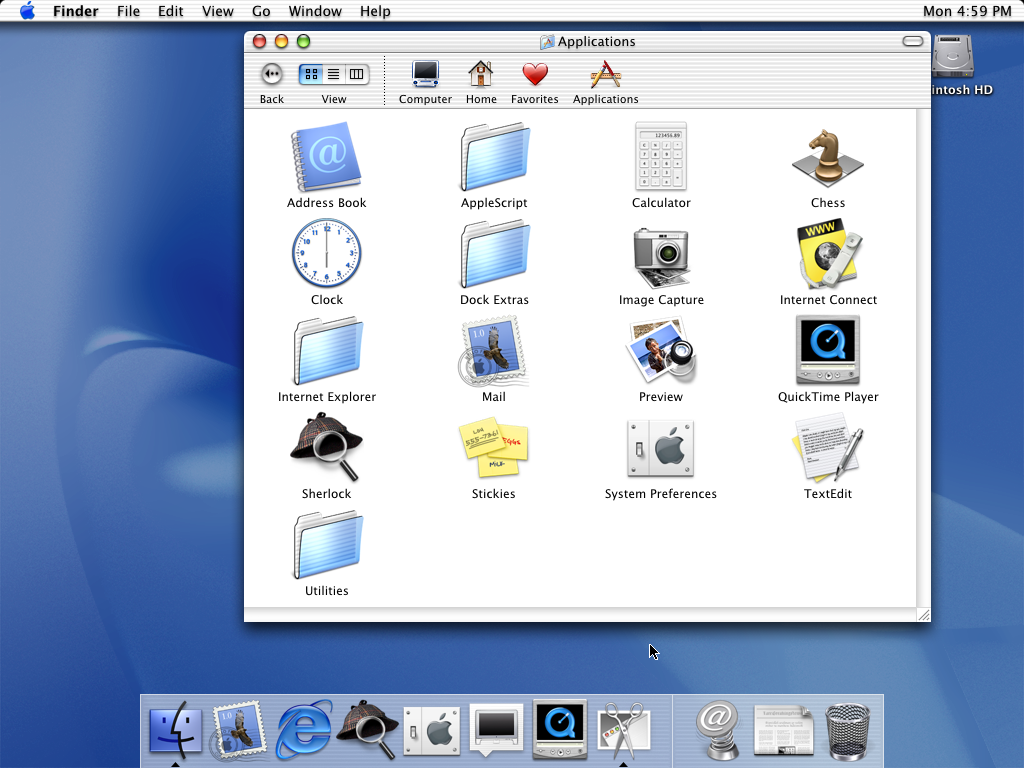
Notice two things:
1) The window chrome with traffic lights and title is entirely separate from the toolbar, not unified with the toolbar.
2) The top of the window is rounded, but the bottom of the window is not!
I think the old design was superior for several reasons, one of which is that it made the windows much easier to drag around the screen. In any case, though, even if there's an argument about concentricity and window controls, it makes no sense that the bottom of the window has the same corner radius as the top when the toolbar is only at the top.
IIRC, you could even "roll up" the window into the top window chrome, with that transparent pill button on the right.
It’s a great desktop environment. I wish I could install it. I’m trying to install the CDE on a parallel’s FreeBSD VM but it doesn’t relaunch after rebooting it.
Agreed.
A better solution would be to adjust the sizing/placement of the window controls (and allow the hit area to include the original placement maybe?).
Mac OS's UX design has been in free fall the last 5-10 years (ever since the "iOS-ify everything" zeitgeist took root). Sincerely hope that they one day revert back, because the current UX is just godawful for any usecase I can imagine.
In hindsight, 90s through 2000s, I think we were coming up in an era of consistent UX refinement and improvement that we took for granted, and that improvement got nailed by mobile transitions (first to phone then to pad and now to AR). MS missed the web, then missed the phone. Apple surpassed them on the desktop but they also made the golden goose (iPhone), pulling focus and consistency away.
I assume it’ll rectify in the vast future, but it’s weird to see regressions in core areas because the new hotness has made it so that these gigantic-corps can’t walk and chew gum at the same time.
I really hope they roll back some of the more obnoxious and pointless aspects of "Liquid Glass" in macOS 27. And the super-rounded window corners are high up on my list. Looks childish, wastes screen space, causes so many little annoyances...
I wish too but they can't just back up, that would be a very bad sign for investors.
Why? What happened to the magic bar? There are many things Apple changed their minds on.
I won’t be surprised if there is a rollback in 27 (i’m hoping there will be - else going to buy a retro mac with a magic bar upon no tahoe runs).
They'll just come up with round displays. Like on PDP-1.
finally, we can run SPACEWAR on macOS as it was always intended to be run.
"In 2015, Dye became the head of Apple's user interface design team"
"Dye also contributed greatly to the design language of iOS 7 in 2013. In 2015, Dye became the head of Apple's user interface design team. In 2022, he played an integral role in the creation of the Dynamic Island, a feature on iPhones and then in 2025, he led the design of Liquid Glass."
Left for Meta in Dec 2025. Hopefully things normalize a bit? Wishful thinking, I suppose.
> ever since the "iOS-ify everything" zeitgeist took root
That started in 2010, a bit more than 5-10 years.
IMHO it started with iOS 7 [1] - year 2013.
Uber flat, you don't know what's a button, what's a text. I dunno if I just adjusted to it or it actually somewhat got better up to iOS/macOS 15. Though with iOS/macOS 26 - it's iOS 7 moment yet again.
NB: not sure about Liquid Glass - though I was recently (and weirdly) recommended to watch iOS 7 trailer on youtube[2]. Comments are overwhelmingly positive. Dunno if it's just people who were kids/teens looking through rose tinted glasses. Though I am not sure anymore, maybe people actually like such designs and it's just HN bubble complaining (IMHO complains here are 110% valid) about nothing. Maybe in 10+ years ordinary guy will praise iOS/macOS 26.
How dare you remind me how old I am ;)
They just might do that, and sell it as revolutionary progress.
What is godawful about it? Tahoe is great. Spotlight shortcuts, LLM actions. “Design is how it works.”
Because Spotlight now rarely finds your applications in search so you can't just quick launch anything.... from a launcher widget
They finally managed to get feature parity with the Windows start menu :)
For around a decade typing "word"+return into the windows start menu search box usually opened Edge with a search result of "ord". Recently it opens Word most of the time.
Love it when it forgets the Mac apps exist, and launches Maps or Calendar in phone mirroring. I use mirroring a fair bit, but never for anything where I have the Mac app installed.
I hide my Dock completely and used to rely entirely on Spotlight for launching. After it failing to work so often, I found Raycast which has not failed me once. I can't see how they don't decide an indexing method/schedule based on a user's Spotlight settings.
My Spotlight was shit. I disabled types of searches that I never used and rebuilt its index. Now it's working as intended.
I haven’t had a single issue with this. I’m guessing many people had this issue immediately after upgrading while Spotlight was still re-indexing and are just running with it since it’s cool to hate Tahoe right now.
No, if this happened to people 2-3 times right after upgrading this wouldn't be something they bring up because the indexing doesn't take months. It's broken. Spotlight used to work almost perfectly since it was introduced and it's been lagging and somewhat defunct since Tahoe.
My search never recovered but I just didn't care to fix it, too many things to fix and my IDE has its own spotlight. I'm normally a vanilla-don't-touch-settings guy.
When I try to launch system settings through spotlight, it launches system info. They have the same prefix, but that's no excuse. Never happened since Tiger or so.
> What is godawful about it?
I'm specifically commenting on their UX decisions, and in that respect literally everything. Tahoe, like every major upgrade, is iterative. Very few things that bowl a person over. Somethings are good, some things are "meh". But Liquid Glass is an abomination.
"Literally everything" Can you give some examples? "Inconsistent corner radius" isn't UX, it's UI. It affects nothing about the experience.
It impacts the experience when you try to resise a window and can't find the corner lol
This was one of the very few advantages of moving from Linux => MacOS, that at least most of the software was beautiful and consistent by default. I'm saddened to see that this is not true anymore. Been holding the Tahoe upgrade, and might just keep my macbook air m1 much longer than originally intended because of this.
I've started using Linux recently after not touching a desktop distro for 20-odd years, and I was surprised how good both Gnome and KDE look these days.
It certainly doesn't feel like there's a trillion-dollar-company difference between those two and Tahoe.
I am in the same boat. I would like to buy a new m5, but being forced to keep Tahoe is preventing me to get it until they fix this clusterfuck
I hear KDE Plasma is nice this time of year. Computers should adapt to fit the user, not the other way around.
Modern Gnome on Fedora feels like MacOS in a good way. Consistent design
Beautiful, it’s nice, but the polished user experience was the ultimate argument.
- Raising the lid of the laptop and the base wouldn’t stick and fall off on the desk,
- A single-button click,
- A Cmd+C to copy and Ctrl+C for the interruption 7 in the terminal,
But now you have to configure that, yes, activate the right-click; yes, activate the three-finger click (wtf, 3 fingers); yes, activate the swipe-across-desktops on the magic mouse, all those items were selling points, so they should have studied the best behavior and implemented it by default on all deployments. But that requires studies, aesthetics, and a taste that only Steeve Jobs had, otherwise everything becomes an option. That’s right, I’m going to paraphrase Jobs’ argument against the 1990ies Microsoft:
The problem with Apple is they have no taste.
> - A Cmd+C to copy and Ctrl+C for the interruption 7 in the terminal,
I really miss that in Linux. That said, some terminals implement smart Ctrl+C which will interrupt if there's no text selected and copy otherwise. But terminal I use (Gnome Console) does not, so I have to press Ctrl+Shift+C to copy text and then I press that in browser and everything exploded because it opens developer tools. So annoying.
What I find confusing and unhelpful is how The Apple OS deals with windows. Say if you have 4 safari windows, 3 excel windows, 5 window word documents and a bunch of terminals spread across a bunch of desktops. To me, I have clearly conceptionalized different work streams into desktops.
Apple doesn’t understand and respect that.
Firstly, alt-tab doesn’t consider windows, it considers apps. So if you have multiple browser windows or word windows open, you can’t alt-tab between them. It’s totally confusing. So I install an app just to get the normal alt-tab behavior of other OSs, to alt-tab between windows (mine is called alt-tab, and it’s a bit buggy and slow, I think they all are)
Next, Apple does not respect the multiple desktop boundary. If I click on the safari icon in the dock, it will switch to some seemingly random safari window in some other desktop. If I close any window, it will also run off to some other window of the same app in some other desktop (who came up with that behavior?) when I dismiss an outlook notification, it will run of to another desktop to look at outlook (actually I think this one is Microsoft’s fault, but Apple could probably do something about this one).
The result is that while working, I have trouble staying on the desktop I’m working on, I constantly am getting sent off to some other random desktop, and have to find where I am and where I was.
There must be a better, more productive way to manage windows and desktops.
(Also what’s up with the autocorrect, I had to retype every instance of “I think” in this message, because it insists it should be “o think”)
> Firstly, alt-tab
I assume you mean cmd-tab.
>doesn’t consider windows, it considers apps. So if you have multiple browser windows or word windows open, you can’t alt-tab between them. It’s totally confusing.
You use cmd-tilde to switch between windows.
>So I install an app just to get the normal alt-tab behavior of other OSs, to alt-tab between windows (mine is called alt-tab, and it’s a bit buggy and slow, I think they all are)
You don’t need an app.
>Next, Apple does not respect the multiple desktop boundary. If I click on the safari icon in the dock, it will switch to some seemingly random safari window in some other desktop. If I close any window, it will also run off to some other window of the same app in some other desktop (who came up with that behavior?) when I dismiss an outlook notification, it will run of to another desktop to look at outlook (actually I think this one is Microsoft’s fault, but Apple could probably do something about this one). The result is that while working, I have trouble staying on the desktop I’m working on, I constantly am getting sent off to some other random desktop, and have to find where I am and where I was. There must be a better, more productive way to manage windows and desktops.
This is a configurable setting.
>(Also what’s up with the autocorrect, I had to retype every instance of “I think” in this message, because it insists it should be “o think”)
This is a configurable setting.
>>Next, Apple does not respect the multiple desktop boundary... > This is a configurable setting.
If you mean the "When switching to an application, switch to a Space with open windows for the application" settings, this works only partially. When clicking the dock icon its behaviour depends on if there are windows in your current Space (virtual desktop) or not. And don't get me started on where macOS decides new windows should go.
> You use cmd-tilde to switch between windows.
the approach is still pretty different in macOS compared to most other WM behaviors, namely: cmd-tilde cycles windows within the currently-open application, and cmd-tab cylces through applications. in most other environments, alt-tab will cycle windows across all open applications (and win-tab does something like cmd-tab on macOS but somehow horribly).
I am mildly shocked after almost two decades of Mac use I never came across cmd+tilde thanks a lot!
I see this comment often and I usually pipe up to say that if you don’t have a US ANSI keyboard it can feel unintuitive. You can remap the hotkey to Option + Tab in those cases, easier to get used to.
Next try CMD+H to hide instead of minimising, like in Windows Land.
It doesn’t go to recently used, it CYCLES through the windows.to get to most recent used, you need to cycle through all the windows of the app. Who came up with that!?
> This is a configurable setting.
Give me pointers please. Getting same headaches every day. Clicking on icon in dock, closing some window produces random results every time, across many, many apps
Apple is no longer about Jobs' "simplicity as the ultimate sophistication". It feels like a bunch of kids with no proper design education competing for the security of their salaries. Apple is dead without Steve. The company has no focal point. They're running solely on the inertia from Mac OS X and the first generations of the iPhone.
That's a pretty extreme take. I've been using the Mac since about 2001. I like Tahoe and a well designed Tahoe app can look really nice on the platform. There are bugs, inconsistencies and other issues, but it doesn't feel that different than many previous macOS / OS X releases
It just seems to me that that Macbook Neo is basically them telling us that come next year they will unify iOS and MacOS and they are testing the waters at the moment.
All this version alignment, the blurring of "here is a laptop with A processor and iOS" points to that direction.
The errs of Tahoe are basically a result of the rush on that direction
If anything, Neo signals they will not merge macOS and iOS.
Why would they if they just released a brand new MacBook?
The SoC is just a way to differentiate from the Air and to keep costs low.
i hope you're wrong. they certainly have seemed to test the waters on many other fronts. the $99/yr notarization fee is now basically required as running unnotarized apps is made hard and scary enough to turn off probably 97% of average users
they also briefly took away the ability to disable gatekeeper per terminal command (now back)
next they wanna launch a touchscreen macbook, presumably this fall
I hope they don’t ever do a touchscreen MacBook. They already have every angle of that use case covered far better than the competition; either you get an iPad if you absolutely need to be pawing at a screen, or you have the excellent trackpads that are far and away par excellence. I don’t see how a touch screen on top of also the industry standard for screen quality will in any way improve by having greasy finger trails distorting the tiny pixels.
Maybe I’m missing something. How would a touchscreen MacBook improve on something?
That being said, based on what I’ve been seeing at Apple, I would not be surprised if they did go down that mediocrity route.
> How would a touchscreen MacBook improve on something?
It won’t, but there’s now an entire generation of users who get confused and angry if any kind of display doesn’t react when you poke it with your finger.
If they're smart they won't do a touchscreen MacBook; they'll do an iPad that reveals macOS when you attach a keyboard.
>they also briefly took away the ability to disable gatekeeper per terminal command (now back)
Does this require a Tahoe upgrade?
I think they have the pathway to merge it right now. But it will cannibalize their sales so they dont want to do that.
I would say the M5 Max MBP, Mac Studio, and the acceptance of Apple hardware as the pinnacle for personal local LLMs are good signs that they are not going to unify iOS and macOS.
The rounded corners is such a key element of apple design. They patented rounded corners on the iphone for precisely this reason. They wanted to trademark this but got a design patent instead. And then samsung notoriously copied this one almost verbatim same radius which pissed off apple.
>one almost verbatim same radius which pissed off apple
So this is what they decided to do? Use so many different rounded radius variations that competitors don't know which one to copy?
> The rounded corners is such a key element of apple design.
See Windows 11.
Windows corner is a lot sharper/smaller than the apple corner.
This specific design decision makes so little sense, really curious on how it got approved. It's not an accident or a miss, since the variable radius got quite heavily promoted during WWDC.
Hopeful they don't wait 7 years to change stance.
This is an issue on Linux too, especially when Wayland is used and applications are responsible for drawing their own chrome. Ugh.
HOWEVER, due to the open nature of the platform, you can install an extension to clean this up. Now, all my windows have identical corner radii, strokes, shadows etc. My Linux desktop is, surprisingly, more consistent now than macOS in this regard.
https://extensions.gnome.org/extension/7048/rounded-window-c...
It is difficult to put into words how much I dislike macos 26. I held out on upgrading for a long time since there were so many horror stories, but to my surprise both iOS and ipadOS 26 aren’t really any different than 18. Maybe because you don’t really do any proper work on it? The graphical differences aren’t anything major when the apps fill the whole viewport anyway.
But macOS? Good lord. I can only hope 27 will unfuck things somewhat, there are so many small annoyances and all of them add to a constant sense of unhappiness throughout the day. I’m really tempted to downgrade back to Sequoia. At least the M4 will be good enough for years if this truly is the new path Apple will take.
On iOS, there are four little white corners beneath my keyboard when im typing on HN. Because HW & SW didnt coordinate on the size of the keyboard rounding vs the new iPhone 17.
Just so, so sloppy. I'm supposed to trust a multi trillion dollar company with my privacy?
Comment was deleted :(
There is a work around if you don't mind lowering the Security settings: https://github.com/aspauldingcode/apple-sharpener
It's annoying, sure, but it's not worth disabling SIP.
I know a lot of people have brought up the corner radius but the left aligned title is such a weird step backwards.
Today when cropping an image in Preview.app on Tahoe I ran into an issue where you can't use the bottom of the crop selection rectangle because the rounded corner of the window blocks it.
Pinch (or CMD + minus) zoom out slightly as a workaround.
Yeah I came right. Just a minor annoyance.
I'm one of the people who actually mostly likes Tahoe. Funny to see how new versions of MacOS always get piled on, in such a groupthink manner.
For me personally, once in used to the new UI, going back seems crude.
This is driving me crazy for some time. Worst with Calendar. (don't looook)
The only question remains, why our community (programmers and scientists) continues funding this completely voluntarily?
don't know why this bothers me but apple is losing attention to detail
A few weeks ago I was thinking about starting https://theghostofsteve.com, where users can come and post their experiences about about Apple devices in 2026. Users would like/dislike with "its genius" or "its shit".
The assumption being that the majority of reactions would be "its shit."
Feels sloppy (is sloppy) but I think the idea is to prioritize OS unification for hardware reasons, and UX across product suite — devices can share data, apps, screens, everything.
I'm seeing a lot of comments here about macOS/iOS unification, but I think people are getting worked up about nothing.
What do macOS window styles have to do with iOS? iOS (mostly) doesn't have windows!
What does the MacBook Neo have to do with iOS, other than coincidentally using some of the same components? Maybe Apple decided to make a cheaper Mac because they thought people might want to buy a cheaper Mac.
They are trying to use a common design language across all their devices, sure. But you would hardly expect them to do the opposite! They might try to make a hybrid tablet/laptop or something at some point, sure, but none of their current moves point inevitably in that direction. Except maybe for software notarization, but that has nothing to do with window corners or cheaper laptops.
They missed some other type of windows like Activity Monitor graphs. Those are even sharper corners!
FYI I just published a follow-up, "The evolution of Mac app window corners": https://lapcatsoftware.com/articles/2026/3/4.html
I will never upgrade from Sequoia and when I'll have no other options migrate to another laptop!
I bought a 3k M3 Max mbp just a couple months away from the Tahoe and liquid glass announcement which I am a little miffed about, but it's still an awesome machine I enjoy using while it's on Sequoia. I am really hoping macOS 27 will be this decade's Snow Leopard
Wow, you’re leaving a lot of great features like Spotlight shortcut calling, Spotlight clipboard history, and LLM shortcuts on the table because of a couple UI inconsistencies. “Design is how it works.”
Just get Raycast for what you mentioned, + much better (the bar is really low tbf) search
Why would I use Raycast when Spotlight has those features built in, and unlike Raycast can directly call Shortcuts?
Because apparently the search function works better mainly, otherwise I haven't tried the new Spotlight yet (I'm not upgrading to Tahoe)
Design is much more than that.
Also, it’s almost as if you can’t imagine that other users might have needs and preferences different from yours.
Why are you shilling so hard for these features?
Because they’re significant improvements to the way macOS works for power users
their username..
Yes, nothing says Marxism like shilling for the most valuable corporation in history. That's definitely the reason why I'm talking about cool new features in Tahoe.
Sequoia is the new Snow Leopard
This article's timeline is mostly accurate, but contains a few inaccuracies:
- Unified toolbar and titlebar dates from much earlier... it was 10.4, not 10.7.
- The brushed metal look was supposed to be applied to "appliance-like" apps as opposed to "document-like" apps... But Apple was never able to stick to that rule themselves.
There are a few design ideas that always turn out to be bad when implemented, but which designers seem to have to learn the hard way. Transparency is the biggest one, but I guess so is excessive rounding now.
It keeps annoying me, too. How can their developers not see this?!
Because that's by design. The windows are meant to have different corner radius, they even explained it at WWDC. Then people forgot and rediscovered it again, like it was some new thing.
I am not saying that it's a good idea to have different corner radius, just that it's nothing new.
> they even explained it at WWDC
Did they explain the reasoning?
> In the new design system, windows now have a softer, more generous corner radius, which varies based on the style of window. Windows with toolbars now use a larger radius, which is designed to wrap concentrically around the glass toolbar elements, scaling to match the size of the toolbar. Titlebar-only windows retain a smaller corner radius, wrapping compactly around the window controls. These larger corners provide a softer feel and elegant concentricity to the window…
Just a bunch of words that raised no red flags, maybe sounded like a decent idea even, but when you see it how is your reaction not “oh, that’s bad”
I feel like this is the design process. You have ideas, they sound ok, you try them out, and then immediately you revert a lot of them. The ideas without the taste to know when not to do something is becoming the new Apple way
I think what they're saying is that larger radii are for 'real windows' that have toolbars and such but there are 'mini windows' and those get smaller radii. It doesn't seem well enough baked for them to release it like it is but there are other UI problems that I've been annoyed about for a long time (in particular shadows around window boundaries so you can never get a truly flat tiled experience).
Rounded corners (and the utterly massive drag area next to them) are touchbar 2.0. Features that no one asked for, has questionable value, and that provides marginal benefit even for its intended audience (touchscreen macs, no doubt).
So, there was no reasoning.
Comment was deleted :(
To align the window corner radius to the window close/minimize/resize buttons distance from the edge of the window.
Except it kind of fails at that too. The window corners seem to be either based on those squircle things or some kind of other varying radii curve which eases out into sides much more gradually than proper circles. The window buttons (close, minimize) the round toolbar buttons anchored to top right corner are based on proper circles. Attempting to center circle in a varying curvature corner results in varying spacing between the circle and corner, which defeats the whole point of why different windows have different corner size (not calling it radius because they are not circles).
When the top right corner contains a search field instead of rounded button, that also seems to use varying curvature instead of capsule with proper circles at the ends. Still results in varying spacing between window corner and the toolbar content.
And that's just the 2 top corners. Attempts to align top corners result in even bigger mismatch with the rest of the window content. For example calculator -> it has a grid of round buttons. While the window corners might match top bar (as good as they can due to different shapes) the main calculation buttons don't match the corners at all.
Similar problem affects many of the popups which have something like confirmation button anchored to bottom right corner.
Rounded scrollbar handle - not aligned with bottom left corner size, instead it awkwardly gets cut of by different amount in each program.
Menus also have this disease. The non circular corner curve of overall menu shape extends way past the corner of item highlight resulting in varying spacing and making it feel almost like whole menu has bulged out instead of flat sides.
Exactly!
And to OC you're replying to: window close/minimise/resize were already equidistant from window edge on macOS 15 and probably earlier.
Here is a screenshot (safari in the background, textedit in front): https://pasteboard.co/OeMBTDKGsTx9.png

In MacOS 26 it's only weirder, because as you say - due to squircle window corners, now we have this constantly varying distance to the edge.
EDIT: I "get" apple's fascination to squircle, but why they made it such a big radius. Probably no one would've complained if they just have changed from current ~15-20px rounded corners into ~15-20px squircles, but they went 50px+ on toolbared windows.
I'd rather have my corners perfect and not have the constant eyesore of pixels bleeding from other windows' corners!
I'm starting to suspect most people at Apple (and Microsoft) just spend time in a browser these days and so they don't notice how the desktop has gone shitty.
I won't be public shaming, but on a .NET podcast I just heard of an internal Microsoft project that took 7 years (!), to become public, it was a plain single Assembly .NET library nothing special (1 DLL).
Which one?
Then why are they rounding windows corners ? Boredom ?
Priorities on what tickets to work on, and Apple being proudly underresourced.
Yep, it’s just ugly IMO
Because they did it on purpose to demonstrate their utter contempt for their users and to show us how wrong we are.
As jarring as "radiuses"? I guess not.
I hadn’t noticed this before, but now I can’t unsee it. UI inconsistencies like that tend to stand out once someone points them out.
I dislike Tahoe too, but this particular thing is not new.
I just did an image search for "classic macos" and one of the first hits was from https://www.versionmuseum.com/history-of/classic-mac-os. Look at those System 1 screenshots, from 42(!) years ago -- round corners on Puzzle and Calculator, square corners on Note Pad and Control Panel! No consistency at all, isn't it infuriating?
Puzzle and Calculator were Desk Accessories (DAs), a special kind of app.
Some cool details here: https://en.wikipedia.org/wiki/Desk_accessory
Like Tahoe, it was deliberate and there's an explanation for the difference.
But I do wonder if people at the time felt the same way.
That led me to https://www.folklore.org/Desk_Ornaments.html which is a very fun read. Interesting to note that the UI style of the DAs is actually not consistent at all, some have round corners and some don't.
I particularly like this Bill Atkinson tidbit at the end:
Bill Atkinson complained to me that it was a mistake to allow users to specify their own desktop patterns, because it was harder to make a nice one than it looked, and led directly to ugly desktops. [...] So he made MacPaint allocate a window that was the size of the screen when it started up, and filled it with the standard 50% gray pattern, making his own desktop covering up the real one, thus protecting the poor users from their rash esthetic blunders, at least within the friendly confines of MacPaint.
(He was totally right, making your own desktop patterns was fun but the standard checkerbard was far and away the best choice.)
“Well actually” in System 1 and later Classic macOS the puzzle and the calculator are ”Desk Accessories” that is applications that can run simultaneously as other apps, even though the operating system does not support multitasking. The rounded corners are there to distinguish them from the current running application.
Yep, I'm aware. Just like Tahoe, it's intentional and there's a rationale behind it. It may or may not be immediately obvious depending on the user, and people may or may not like the way it looks.
> this particular thing is not new.
Article author here. I think the quoted claim is somewhat misleading. There are at least two different ways to interpret a UI feature as "not new":
1) The feature has been in the operating system all along.
2) Something analogous existed 40 years ago and then disappeared long ago.
You're referring to 2, not 1.
The only reason I chose Calculator app for my screenshot is that its window is very small, which allowed me to make a small screenshot, because people may be reading the blog post on small phone screens. In other ways, admittedly, Calculator is not a great example, because its window is not actually resizable, and thus it's not the type of window that you would normally place in the corners of your screen, like a resizable document window.
Rounded corners on a "widget" type of app are not as objectionable. As other commenters have noted, the calculator in "classic" Mac was a special Desk Accessory. In contrast, on Tahoe, the varying corner radii affect ordinary document-based apps.
Consider Mac OS X 10.0 Cheetah. The top of the windows had rounded corners, but the bottom did not! https://512pixels.net/wp-content/uploads/2018/08/10-0-Cheeta...
TextEdit, for example, did not start to have rounded bottom corners until Mac OS X 10.7 Lion, which was itself much maligned for bringing the iPhone UI to Mac.
Thanks for the thoughtful and detailed response!
You're right, what I had in mind was 2, although a bit more general; I think there have been similar kinds of inconsistency in the Mac UI since the beginning, in various forms, almost always intentional.
So I think it would be wrong simply to say "the UI has gone a cliff, they've just thrown away their own HMI guidelines." You can certainly dislike what they've done (and I do dislike it!) but they at least have a somewhat logical goal in mind -- in this case, making the corners neatly fit various different kinds of window content.
Having said all that, there are also some real bugs and unintentional glitches, like scroll bars and other widgets not fitting correctly. I'd agree that seems to be happening more often in recent years, so their quality control has gone downhill.
> So I think it would be wrong simply to say "the UI has gone a cliff, they've just thrown away their own HMI guidelines."
My own view is that Mac OS X 10.5 Leopard was the beginning of the end, and it's gone downhill ever since.
> they at least have a somewhat logical goal in mind -- in this case, making the corners neatly fit various different kinds of window content.
I would emphasize "somewhat", because as noted, the corners do not neatly fit the window content at the bottom, which is ironic, because Apple claims that their intention is to emphasize the content, but their implementation actually clips the content!
This feels like one of those "done for backwards compatibility and we tested not doing it and it was worse" things where everyone assumes incompetence over good-faith trade-offs being driven by release schedules.
It's by design. This isn't a bug or a skipped test case.
https://developer.apple.com/videos/play/wwdc2025/310/?time=4...
> Each element is designed with a curvature that sits neatly within the corner radius of its container, in this case the window itself. And this relationship goes both ways. In the new design system, windows now have a softer, more generous corner radius, which varies based on the style of window. Windows with toolbars now use a larger radius, which is designed to wrap concentrically around the glass toolbar elements, scaling to match the size of the toolbar. Titlebar-only windows retain a smaller corner radius, wrapping compactly around the window controls. These larger corners provide a softer feel and elegant concentricity to the window but they can also clip content that sits close to the edge of the window.
Design for the sake of design. That entire paragraph reads like a post-hoc justification for a design decision they never thought through
Did the radius need changing
Something needed changing! And the radius was something!
What if they randomized the radius on every launch? A fresh, modern experience every time!
Make it “on every corner” and we have a deal.
(EDIT - and Gemini could create a plausible explanation post-hoc each time)
different radius on every corner and we're back in the winamp skin era, not bad!
Don't give them ideas
Finally, the update we've all been waiting for
[dead]
Why should the two window varieties have the same corner radius? There's no design analysis here, only conservatism.
Because when they overlap, you want to resize the top one.
The bottom of windows show have no corner radius at all. For most types of content it sacrifices usable space for UI chrome. It also makes resizing harder and scroll bars ugly.
I actually really like that certain windows have a different corner radius. It wraps around the chrome of the app properly.
If you made it this far, know I am totally messing with you. It really is unnerving.
read somewhere that maybe they’re preparing for OLED screens
How does that argument work?
which will be even worse so you don't get that angry after years of bad design, lol
O from OLED is round. That's why they need rounded windows. /s
All iPhones since the iPhone X (2017), and not the iPhone SE line, has an OLED display. iPad Pro also has OLED.
There's also been rumours of a new high-end OLED MacBook ("Ultra"?) in the works, possibly this year.
If it is that crucial, they should add a few pixels of margin around the entire desktop, and randomly shift everything around. Doing only corners and not straight edges, and doing it by a fixed per-app amount, seems a bit silly.
Comment was deleted :(
is there a reason to downvote this?
Im gonna go against the grain here, so hold your pitchforks please, but I think its better than if it were consistent. Let me explain:
The author notices that adding a toolbar changes the radius, and to me it makes sense. If theres a toolbar, I know how much I can cut the corners, because the icons in the toolbar are not gonna be in far corner. At the same time, when I am unsure about what type of content might get cut by the corner, I will reduce the cut slightly to give that content more space.
I couldnt care less that one radius is not the same as another, I guess my OCD levels are not that high (yet?).
And I say all of this as someone who dislikes the glass design, and especially hates the small, slowly fading in volume/brightness indicators in the corner replacing the mid screen beautiful instant indicator.
So… the moment the Interface Designer in XCode can identify the app only has a single button at the center of a window, the window should be a circle? :)
No, because circles are not as cool as squircles.
Containers with different contents look different?
I don't see the big deal. That seems like a reasonable design choice. Make nice rounded corners when content allows, but rectangle them up as needed?
Seems like a nice adaptive design choice.
Honestly making different apps slightly more visually identifiable in a sea of sameness doesn't seem like a big deal.
Maybe this is intentional? Either way, doesn't look bad.
I suppose that's subjective, because to me it looks distracting and tacky. I want the window chrome to be present, opinionated, yet consistent and plain. This is one of the many Tahoe-isms that violates the latter two. It's visual noise that detracts from one of the most basic utilities of the UI, which is to simply hold my applications in a regular, cohesive, predictable manner.
Maybe it shouldn't irritate me, but it's the first time I've encountered it in 30 years. I'm all for change and trying new things, but this doesn't feel like progress.
This 100%. I _like_ new features and new UX when it enhances things or makes them easier to work with. That used to be a huge selling point when purchasing a Mac vs PC, genuine thought and consideration had been given to every single interaction and user impact.
And then ... Apple lost its way. Now when I get a new Mac I spend the better part of a day turning off as much of the pointless eye candy as I can so that I can focus on the task I'm working on, not the distracting UX conventions.
I want a computer, not an iPad with a keyboard. That already exists, and there is a reason I don't have one.
> turning off as much of the pointless eye candy as I can so that I can focus on the task I'm working on, not the distracting UX conventions.
What's worse too is that the means of reducing this distraction and visual mess are arguably only a trade for a different, often equally (though sometimes even more) poorly implemented interface. The high contrast and reduced transparency modes are not well designed at all in my opinion, and they seem like vague afterthoughts in this transition.
It is intentional - it was explained at WWDC. And it looks good.
OK, Tim Cook, nice try but it looks awful.
This is one of those stories that I read and I'm like, "Someone wrote an article about that? I am definitely among my people, but I smell a front end developer."
Crafted by Rajat
Source Code